
On Friday — scrutineering day — the weather gods at the Grossglockner were not
benevolent. Rain and wind swept through the paddock, fog covered the mountains — conditions reminiscent
of the last great races in 1938 and 1939.
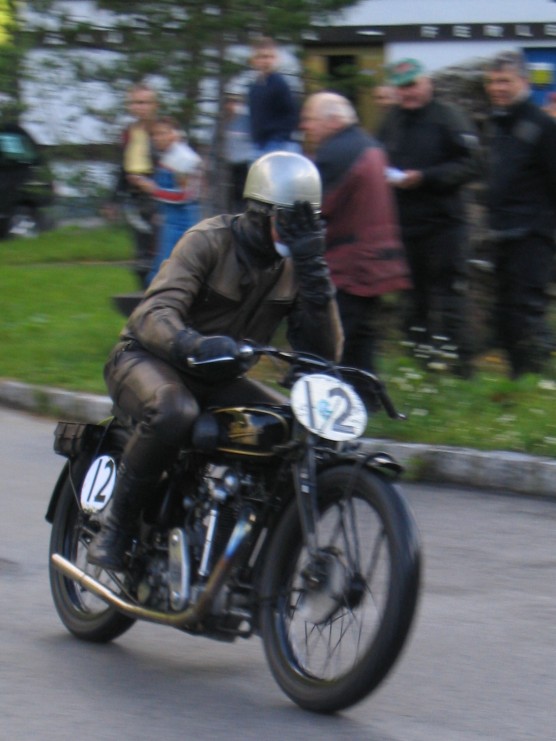
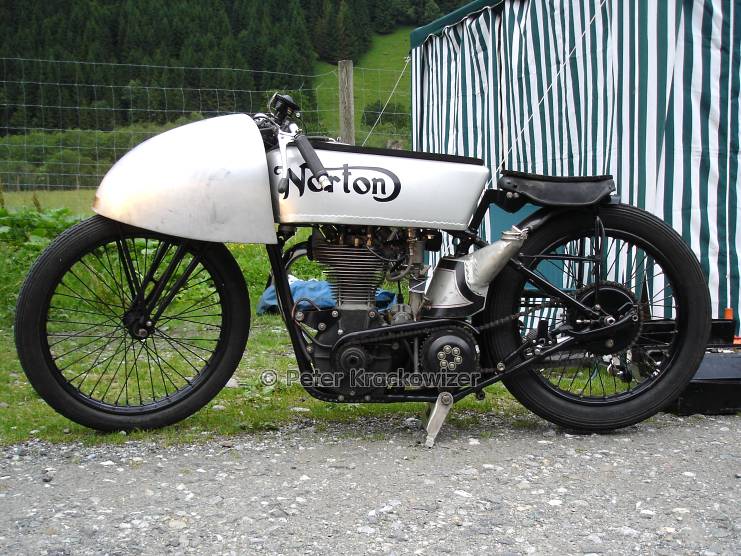
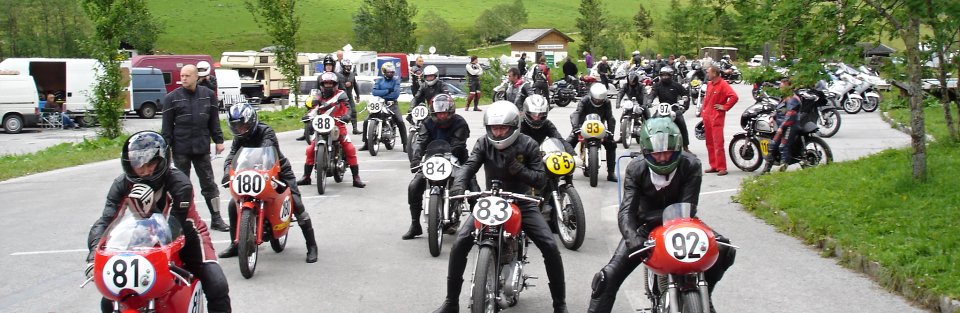
AJS Kettles, NSU Bullus, Rudge Ulsters, Moto Guzzis, Norton Internationals and Manx models,
Velocette KTT Mk IV, VIII and MAC, Matchless, BMW, Bultaco, Aermacchi, Moto Morini and many other marques
prepared themselves for the start. When the weather cleared at 8 a.m. on Saturday, 3 July, spirits rose
considerably.
The higher a rider’s starting number, the better and drier the road — and the warmer the air.
Even spectators began to appear, and by midday more than two thousand had gathered.
By 10:20 a.m. all riders had returned to the paddock, as the road was closed in both directions.
Although the bikes started at 30‑second intervals, they coasted back down en masse from 2,000 metres above
sea level.
Terrible luck befell David Lawrence from England. On his first — and what
became his last — run, his Douglas (1949, 498 cc) lost a plug cap from one of its transverse cylinders.
With the throttle held wide open to maintain momentum, Lawrence pushed the flailing plug cap back on and
the engine roared to life again. Leaned over in a tight corner, the bike spat its rider onto the road and
tore an entire cylinder from the crankcases.
Up to the start of the second heat at 5 p.m., the paddock was filled with nostalgic
motorcycling romance. Peter Hinterreiter had set up beer tables in front of his van, complete with a
“kitchen brigade” (the ladies), a grill and a small improvised bar — a cosy meeting point for conversation.
Sammy Miller could be found in John Biggs’ motorhome at a central spot in the paddock, always “in contact”
with everyone. Peter Huber and his son Anton enjoyed the warm summer day. News spread that the summit of
the Grossglockner (3,798 m) and the Pasterze glacier were now free of clouds. The roads were dry and the
restart at 5 p.m. seemed assured.
In the marquee of “AUDI Porsche Alpenstraße Salzburg” one could admire precious machinery on
two and four wheels: the 1939 Velocette KTT Mk VIII, 350 cc, ridden by F. J. Binder and later, in 1949, by
Professor Helmut Krackowizer, stood beside the Auto Union Grand Prix racing car Type C with its 16‑cylinder
engine and the DKW 250 SS.
The unique car designed by Ferdinand Porsche produced 295 hp at the wheels
in 1934. After two years of development, the V‑16 delivered 520 hp in 1936. The car competed in 59 races and
won 33 outright.
Up on the Grossglockner the weather began to deteriorate again, but several thousand more
spectators had gathered to enjoy the spectacle.
In the starting area, Peter Krackowizer — one of the sons of the “racing professor” —
commentated knowledgeably on the history and the motorcycles.
Sammy Miller opened the second heat, storming up the mountain at an average speed of
72.4 km/h. Gustl Hobl made the hill echo with the sound of his DKW.
Organizer Thomas Fritsch had been second fastest in the first heat and was determined to win.
Perhaps he pushed too hard, for he crashed heavily on a long left‑hand bend three kilometres from the start,
bounced off a wall and ended up in an ambulance — spending the night in hospital with broken ribs and severe
bruising. A replacement ambulance had to be brought in before the race could restart.
To close the day in perfect conditions, the entire field returned to the paddock and then to
the prize‑giving ceremony at the “Lukas Hansl” Hotel opposite the paddock.
Grossglockner Trophy 2004 Memorial "Mister Rudge", Helmut Krackowizer
Posted December 2012 by Peter
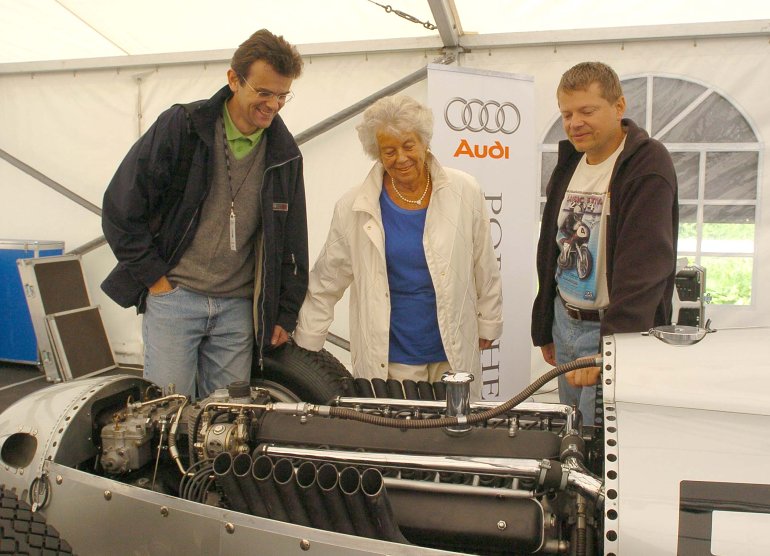
from left: Alfons Fischer
Porsche Alpenstraße
Inge Krackowizer,
Thomas Fritsch
© Lauxfoto Salzburg
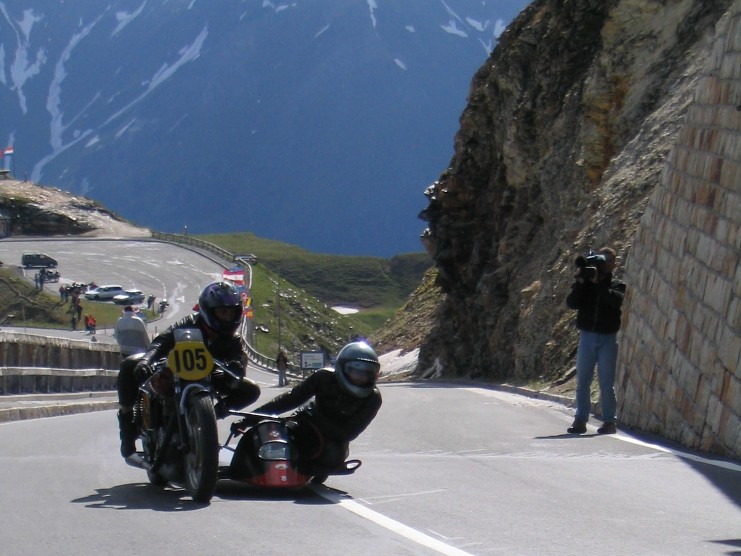
Luzza and Uschi Cadonau
Gilera Saturno 500, 1950
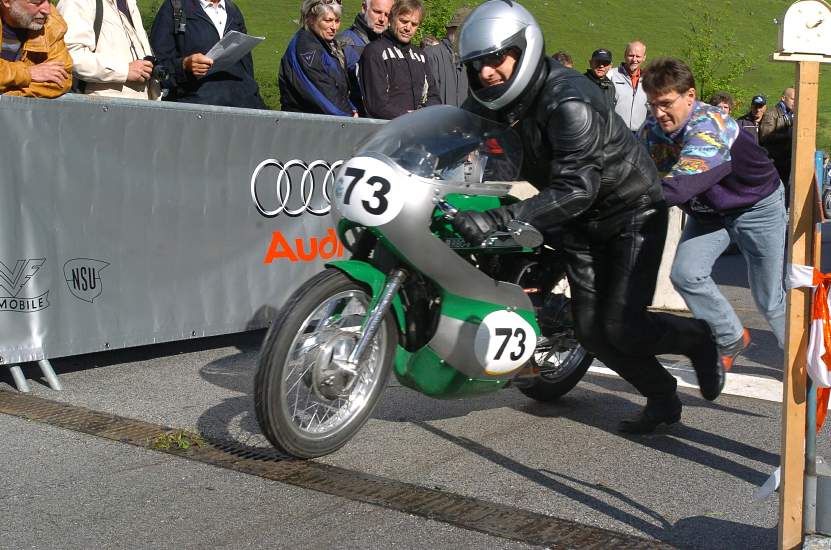
Ing. Hermann Stöckl
Puch 350 cm³
© Lauxfoto Salzburg
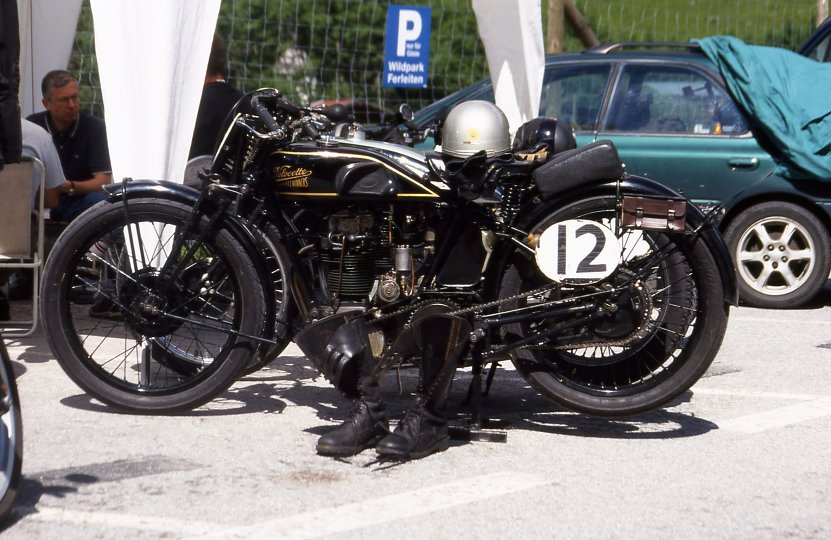
Richard Mills
Velocette KTT MK IV, 1934